Weight Transfer Explained for Track Drivers
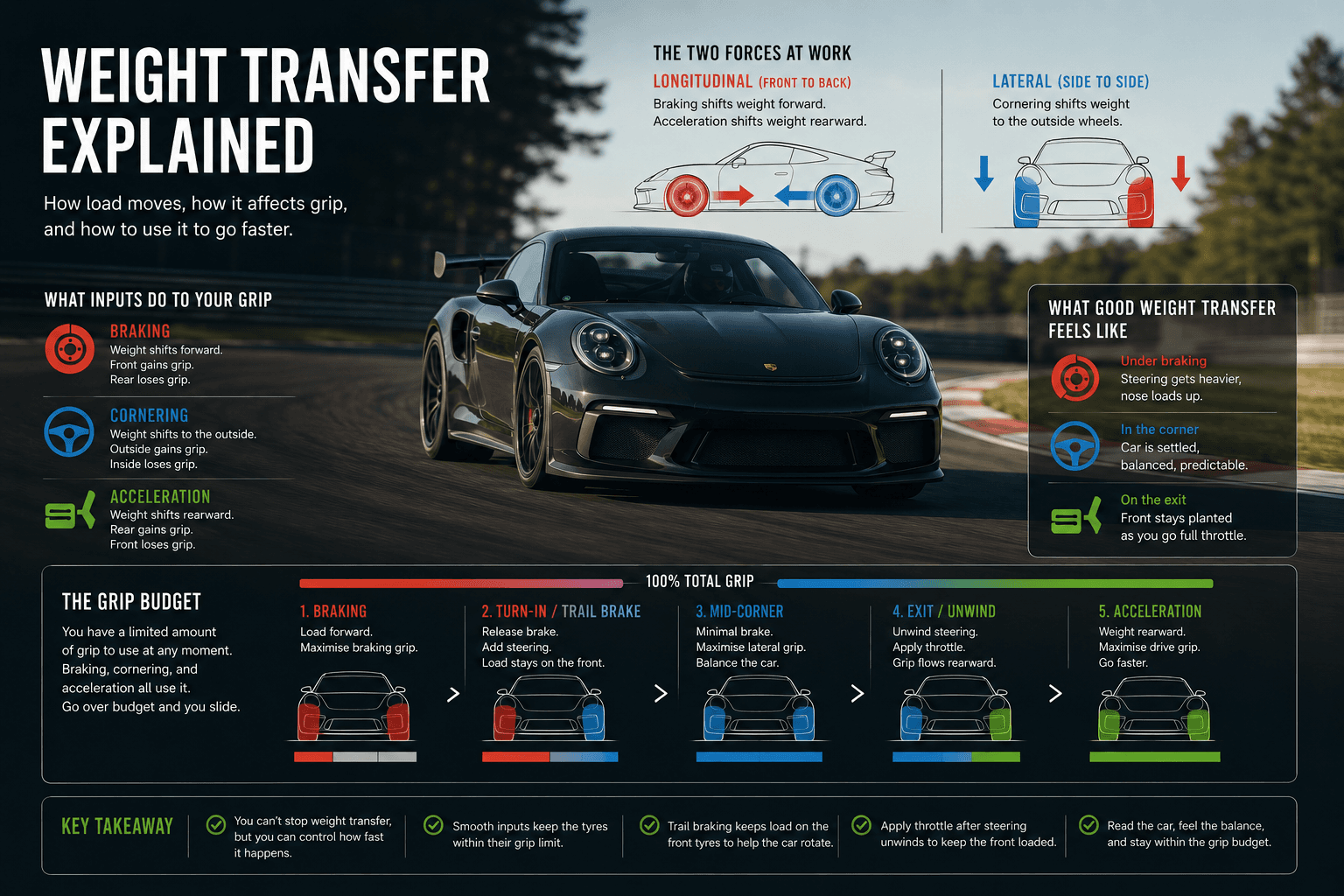
Weight transfer is the way load moves between your tyres every time you brake, turn or accelerate, changing how much grip each tyre has at that moment.
That's the whole idea in one sentence, and most drivers nod along at it. But how well you manage that movement is what separates a driver who feels in control from one who's always reacting to what the car is doing. Nearly every handling complaint I hear at a track day, the car won't turn, the rear feels nervous, it runs wide on the exit, traces back to load being in the wrong place at the wrong moment. So let's do this the way I teach it in the programme: what's actually moving, what it does to your grip, and what you can do about it.
Longitudinal and lateral, the two forces at work
Two terms worth getting straight first, because they run through everything that follows. They sound technical, but they're straightforward.
Longitudinal forces act along the length of the car, front to back. You feel them under braking and acceleration. Brake hard and the weight shifts forward onto the front tyres. Get on the throttle and it shifts rearward onto the rear tyres.
Lateral forces act across the car, side to side. Turn into a corner and the weight moves to the outside wheels. The outside tyres compress, the inside tyres unload, and that determines how much grip the car has to corner with.
Those two forces are working constantly and simultaneously, every single lap. And they are always competing for the same grip from your tyres. That competition is the part to hold onto, because it's the reason a corner has to be driven as one connected sequence rather than a set of separate actions.
What braking and throttle actually do to your grip
When the car is stationary, the weight is spread reasonably evenly across all four tyres. The moment you touch the pedals or turn the wheel, that balance shifts. And the grip shifts with it.
Under braking, the front tyres load up and gain grip. The rear gets lighter and loses it. That's why a car can feel planted at the start of a braking zone and then loose and nervous as you start to turn in. If you're still carrying too much brake pressure into the corner, the rear simply doesn't have the grip to stay settled. That isn't the car being difficult. That's load.
Under acceleration, the opposite happens. Weight goes rearward, the rear tyres gain traction, and the front gets lighter. Get on the throttle too early or too aggressively mid-corner and the front will run wide. Not because the car is broken, but because you've taken the load off the tyres that are supposed to be steering.
That last one is the one I see most at track days. A driver feels the car push wide on exit, decides the car understeers, and starts looking at setup or tyres. Nine times out of ten the throttle simply arrived before the steering had finished its work, and delays full throttle down the straight that follows.
Every tyre has a limit, and weight transfer decides how close you are
Here's the key thing to understand. Every tyre has a maximum grip limit. Load it up within that limit and it works with you. It steers, it brakes, it holds the car on the road. Push beyond that limit and the tyre loses grip. It slides.
Weight transfer is exactly what determines how close to that limit each tyre is at any given moment.
The way I teach it is as a budget. A hundred units of grip to spend at any moment. When you're braking hard in a straight line you're spending nearly all of it on stopping the car, which means there's almost nothing left to turn with. That's not a flaw in the car. That's physics. As you begin to release the brake and turn in, you're freeing up braking budget so that grip can flow into cornering. You're not switching from one to the other, you're gradually redistributing what you're spending. Less braking, more lateral grip, all the way through to near the apex. Then as you unwind the steering on the exit, that lateral grip starts flowing into acceleration.
Go over budget and something has to give. Try to spend a hundred and ten units when you only have a hundred available and the tyre slides. That's what understeer and oversteer actually are: you've exceeded the available grip in one direction. The front pushes wide, or the rear steps out. Not because the car is misbehaving, but because you've gone over budget.
And the budget isn't fixed. It changes constantly. Tyre temperature, tyre wear, track surface, and the amount of aerodynamic downforce at different speeds all affect the size of it from one corner to the next. Your job as a driver is to read it and adjust accordingly.
You can't stop the weight moving, but you can control how fast
This is where the technique lives. You can't stop weight from transferring, it's going to happen every time you use any input. What you can control is how quickly it moves.
Smooth inputs keep the weight moving at a rate the tyres can manage. Abrupt inputs, a sharp stab at the brake, a sudden lift of the throttle, a quick flick of the steering, move the weight faster than the tyres can respond to. And that's when you exceed the limit and the car becomes unstable.
Smooth drivers aren't smooth for the sake of it. They're smooth because it keeps the tyres within their limit and the car balanced.
That reframes the usual advice. "Be smooth" on its own is a personality note. Knowing that you're managing the rate at which load arrives at a tyre gives you something specific to do with your hands and feet. A firm, decisive initial brake application isn't unsmooth, because the load arrives in a way the front tyres can take and use. A late panic stab at the same pedal is. Same pedal, similar pressure, different rate. More on building that first application in Threshold Braking Explained.
Trail braking is weight transfer used deliberately
The clearest example of managing transfer on purpose is the brake release into a corner.
As you approach turn-in, brake pressure starts to reduce while steering angle builds, and those two inputs are linked directly. As the steering builds, the tyres shift their grip toward cornering, so braking demand has to reduce at the same rate. Release the brake too quickly and the front unloads suddenly and the car pushes wide. Hold too much pressure into the steering and the rear becomes unsettled.
Done properly, the release keeps load on the front tyres deep into the corner, and that front load is what gives you the grip to rotate the car. By that point the speed reduction is done, what's left is balance and rotation. That's trail braking, and I've broken it down fully in Trail Braking Explained. It isn't a separate trick, just weight transfer used on purpose.
What it feels like once you start reading it
Weight transfer is something you'll start to feel rather than just understand. You'll feel it through the steering as the front loads up under braking. You'll feel it through the seat as the car rolls into a corner.
As your feel develops, you'll start to sense how much you have left to spend. The steering gets lighter, the car moves just a touch, and you'll know you're close to the edge. Right on the limit, but never past it. Once you start recognising those sensations, you'll know what the car is telling you, and more importantly, what to do about it. That's when driving stops being reactive and starts being deliberate.
How to work on it at your next track day
Don't try to manage all four tyres at once. Pick one input for a session and pay attention to what the car does when you use it.
Start with the first moment on the brake. Does the nose drop? Does the steering get heavier? That's the front loading, and it means the corner is being set up properly. Then take a corner where you know you run wide on the exit, and watch how early your throttle arrives relative to the steering unwinding. If the front is going light before it has finished turning the car, you've found your answer, and it isn't the setup.
Then look at your onboard. Spot the unwind of the steering as the throttle starts being applied. The order those two things happen in tells you more about your weight management than a lap time will, and I've written about that diagnostic habit in How to Improve Your Lap Times.
Weight transfer is one technique. The corner is a connected sequence. The TrackPro membership teaches the whole method from the ground up: the full Driver Performance Programme, the driver tools including the Dynamic Grip Visualiser, and a monthly onboard breakdown of your own driving. Join TrackPro and stop guessing where the time is going.
Not sure where your weak points are? The free Driver Assessment will tell you in nine questions.